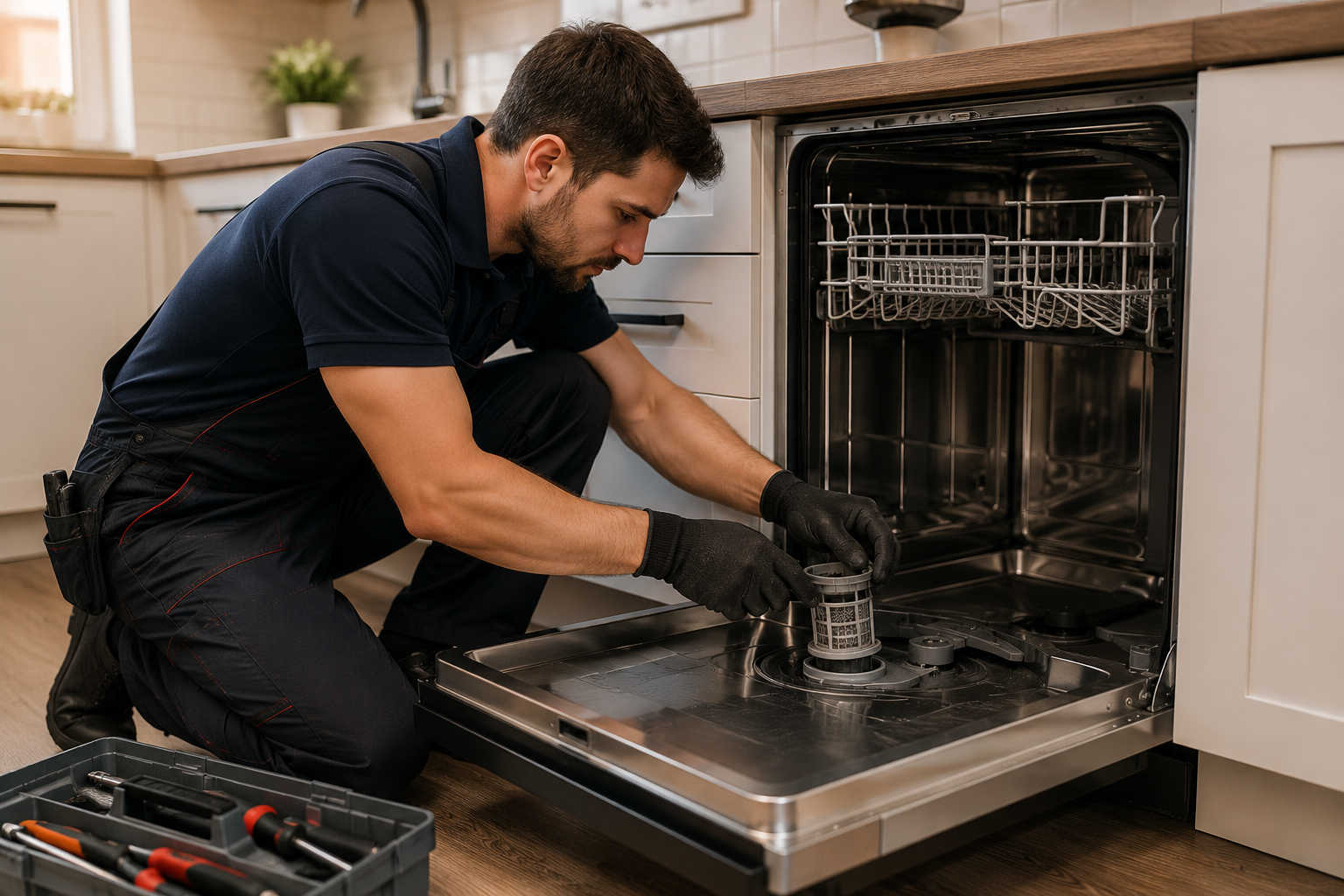
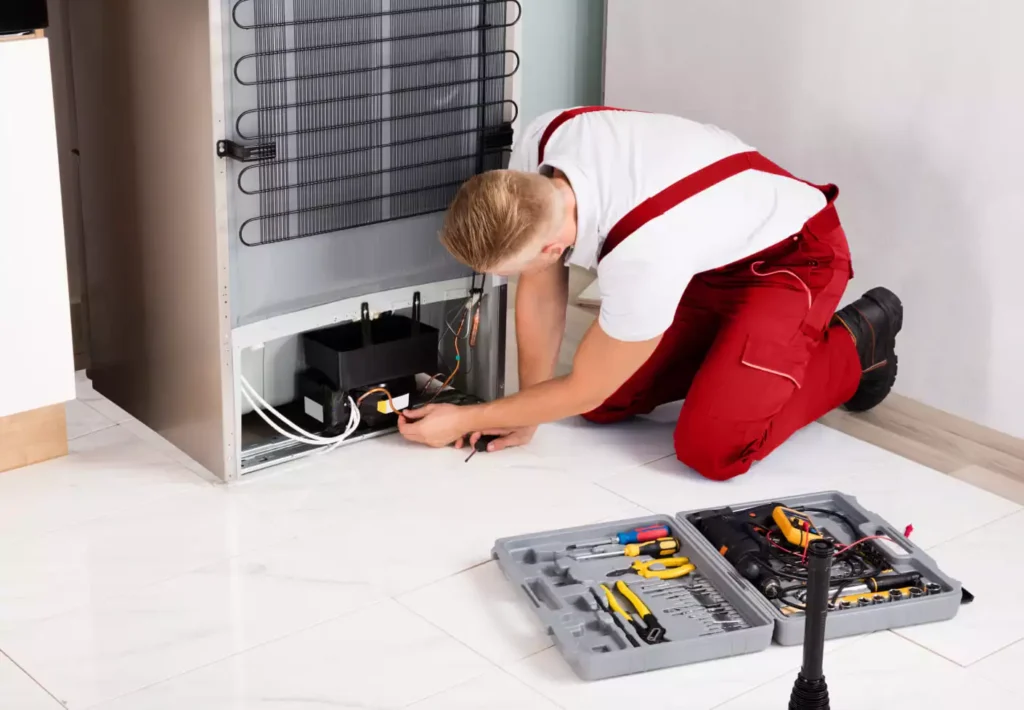
The most common refrigerator problems in Kitchener homes are a fridge that won’t cool, frost buildup in the freezer, water pooling under the unit, constant running, and unusual buzzing or clicking noises. Roughly half of these start with a dirty condenser coil, a failing defrost component, or a worn door gasket. Call a technician when the fault involves the sealed refrigerant system, the compressor, or the control board.
What Your Fridge Is Actually Telling You
Most people call us with one of five sentences. “It’s not cold.” “There’s water on the floor.” “The freezer’s full of ice.” “It never shuts off.” “It’s making a noise it didn’t used to make.”
Each of those points to a different part of the machine. Below is the diagnostic table our technicians use on the phone before we even load the van.
Refrigerator Symptom Diagnosis Table
| What you’re seeing | Most likely cause | Safe to check yourself? | Typical urgency |
| Fridge not cooling, freezer fine | Evaporator fan motor or defrost system | Listen for the fan when the door switch is pressed | Within 24 hours |
| Both compartments warm | Condenser coils, condenser fan, or compressor | Vacuum the coils | Same day — food safety |
| Freezer full of frost or snow | Defrost heater, defrost thermostat, or timer | Check the door seal for gaps | Within a few days |
| Water pooling under the unit | Clogged or frozen defrost drain, cracked water line | Check the drip pan and drain hole | Within a few days |
| Runs constantly, never cycles off | Dirty coils, failed door gasket, thermostat fault | Do the dollar-bill gasket test | Within a week |
| Loud buzzing or humming | Condenser fan obstruction or compressor strain | Pull the unit out and look for debris | Within a few days |
| Rapid clicking every few minutes | Compressor start relay failing | No — call | Same day |
| Ice maker stopped producing | Water filter, inlet valve, or ice maker module | Replace the filter | Within a week |
| Food freezing in the fresh-food section | Damper control or temperature sensor | Check the thermostat setting first | Within a week |
| Fridge warm, freezer cold | Blocked air damper or evaporator fan | Check for packed-in food blocking vents | Within 48 hours |
Why Fridges Fail Differently in Kitchener and Waterloo Region
This is the part most national appliance blogs miss. The Waterloo Region operating environment genuinely changes which components fail first.
Hard groundwater is the number one local factor
Kitchener, Waterloo and Cambridge draw a large share of their municipal supply from groundwater wells rather than surface water, and that water is hard. For a refrigerator, hardness matters in three specific places: the water inlet valve, the ice maker fill tube, and the water filter cartridge.
We see scale-related ice maker failures here at a noticeably higher rate than technicians report in surface-water cities. If your ice cubes have gone small, hollow, or cloudy, or the dispenser has slowed to a trickle, mineral scale in the inlet valve is the first thing we check, not the ice maker assembly, which is the expensive part people usually assume has failed.
Practical takeaway for Kitchener homeowners: change your fridge’s water filter every six months rather than the manufacturer’s default of every twelve. In this water, twelve months is optimistic.
Garage and basement fridges have a Kitchener-specific problem
Southern Ontario’s humid continental climate swings hard. A second fridge in an unheated Kitchener garage sits in 30 °C-plus humidity in July and can drop below 5 °C in January.
That second condition is the one nobody expects. A standard refrigerator’s thermostat reads the fresh-food compartment. When the surrounding garage air is already colder than the fridge’s setpoint, the compressor simply stops cycling, and because the freezer shares that cooling system, the freezer thaws while the fridge appears to be working fine. Every winter we get calls from homeowners in Doon South, Huron Park and Forest Heights who lost a freezer full of food this exact way.
If you keep a beverage or overflow fridge in the garage, buy a garage-rated model or a garage conversion kit. A standard unit is not designed for it.
Older housing stock versus new builds
Kitchener’s housing mix creates two distinct failure profiles.
Century and mid-century homes: Victoria Park, Central Frederick, Cedar Hill, Mount Hope–Breithaupt Park, and much of Hespeler and Preston in Cambridge typically have narrow galley kitchens where the fridge is boxed into a tight alcove with minimal clearance at the rear and top. Refrigerators reject heat out the back and underneath. Starve them of airflow, and the compressor runs hotter, longer, and dies years early. In these homes, we very often find the actual “fault” is a clearance problem, not a component failure.
Older homes also more often have the fridge sharing a circuit with other kitchen loads, which produces intermittent, hard-to-diagnose behaviour that looks like a control board fault.
Newer subdivisions – Doon South, Huron Park, Williamsburg, Laurentian Hills, Wallaceville, Eastforest, and the newer Trussler-area developments bring the opposite profile. Open-concept kitchens with counter-depth, French-door and panel-ready built-in refrigerators. These units run tighter tolerances, are far more likely to have plumbed water and ice, and carry more electronics: inverter compressors, dual evaporators, Wi-Fi modules, touch-panel controls.
They break less often, but when they do, the diagnosis is genuinely more technical, and the parts are model-specific. A counter-depth built-in is not a repair to guess at.
Student rentals, duplexes and secondary suites
Waterloo Region has a large rental and student-housing footprint the University of Waterloo and Wilfrid Laurier catchment in Waterloo, and Kitchener’s growing stock of legal duplex and basement-suite conversions.
Shared-household fridges take a beating: doors opened constantly, gaskets torn, shelves overloaded, vents blocked by packed food. In these units, door gasket failure and blocked evaporator airflow account for the majority of “it’s not cooling” calls. Both are inexpensive fixes if caught before the compressor has been running 24/7 for six months trying to compensate.
Landlords and property managers across Kitchener, Waterloo and Cambridge: the single highest-return maintenance item you can schedule is an annual gasket-and-coil check on every unit. It costs a fraction of a compressor.
The Seven Most Common Refrigerator Problems, Explained
The refrigerator is not cooling
A refrigerator that isn’t cooling usually has one of four faults: condenser coils choked with dust, a failed condenser or evaporator fan motor, a defrost system failure that has iced over the evaporator, or a compressor that is no longer pumping. Clean the coils first it resolves a meaningful share of no-cool calls and costs nothing.
Here’s how to narrow it down before you call.
Pull the fridge out and put your hand on the back. If the black coils are hot and the compressor is humming, the sealed system is running; your problem is airflow or defrost, not the compressor. If the compressor is silent and cold, or clicking on and off every few minutes, that is a start relay or compressor issue, and it needs a technician.
Next, open the freezer and press the door switch. You should hear the evaporator fan spin up. Silence means a failed fan motor or an evaporator so iced over the fan blade is frozen in place.
What you can safely do yourself: unplug the unit, vacuum the condenser coils underneath or behind, confirm nothing is blocking the vents inside, and verify the temperature setting hasn’t been knocked.
What needs a technician: anything involving the compressor, the start relay, refrigerant charge, or a sealed-system leak.
2. Frost or ice buildup in the freezer
Heavy frost buildup means the automatic defrost system has failed. Every frost-free refrigerator runs a defrost cycle several times a day using a defrost heater, a defrost thermostat, and a timer or control board. When one of those three fails, ice accumulates on the evaporator, chokes airflow to the fresh-food compartment, and the fridge slowly stops cooling.
This is the fault that most often gets misdiagnosed as “the fridge is dying.” It usually isn’t. It’s typically one inexpensive component, but identifying which of the three requires meter testing, not guesswork.
A warning sign worth acting on: if your fridge section is warming up while the freezer still feels cold, you very likely have a defrost failure in progress. Ice has blocked the duct that moves cold air from the freezer’s evaporator into the fridge compartment. Manually defrosting the unit will restore it temporarily for a week or two which is exactly why so many people delay the real repair.
3. Water leaking onto the floor
Water under a refrigerator comes from one of three sources: a clogged or frozen defrost drain, a cracked or loose water supply line, or a failed water inlet valve. Defrost drain blockages are the most common and the least expensive. Water lines and inlet valves involve the household plumbing connection and should be handled by a technician.
Trace the water before you mop it. Water at the front of the unit, inside, along the bottom of the fresh-food compartment, is almost always a blocked defrost drain meltwater that can’t reach the drip pan. Water at the back points to the supply line or inlet valve.
Do not let this sit. Kitchener’s older homes frequently have original hardwood or subfloor under the kitchen, and slow refrigerator leaks are a common source of the floor cupping and mould we find behind units that have been leaking quietly for months.
The refrigerator runs constantly and never shuts off
A refrigerator that never cycles off is losing cold air faster than it can produce it. The usual culprits are dirty condenser coils, a worn or torn door gasket, an over-packed compartment blocking the vents, or a thermostat that isn’t reading correctly. Constant running drives up hydro costs and shortens compressor life significantly.
The dollar-bill test: close a bill in the door so half sticks out. Pull it. If it slides out with no resistance, that section of gasket has lost its seal. Repeat it at six or eight points around the door gaskets; usually fail in one spot first, typically the hinge side or a bottom corner.
For Kitchener homeowners on time-of-use electricity rates, a fridge running 100% duty cycle instead of a normal 40–50% is a real and ongoing cost, on top of the wear it’s putting on the compressor.
5. Strange noises: buzzing, clicking, rattling
A normal refrigerator hums quietly and gurgles occasionally as refrigerant moves. Loud buzzing usually means the condenser fan is obstructed or its bearing is failing. Rattling is often a loose drip pan or the unit contacting a wall. Rapid clicking every few minutes is the most serious — that is the compressor start relay attempting to start a compressor that will not run.
Take the clicking seriously. A start relay is a modest repair. A seized compressor, on most units, is the point where replacement becomes the better economic decision. The window between those two states is often weeks.
Ice maker not working or producing poor ice
Ice maker failures in Waterloo Region are disproportionately water-quality related. Before replacing the ice maker assembly, check the water filter, the inlet valve screen, and the fill tube for mineral scale. Small, hollow or slow-forming cubes almost always indicate restricted water flow rather than a failed ice maker module.
This matters financially. An ice maker assembly is one of the pricier refrigerator components, and it is replaced all the time unnecessarily. In hard-water areas like ours, the actual restriction is usually upstream and far cheaper to resolve.
7. Food freezing in the fresh-food compartment
When lettuce and milk freeze in the refrigerator section, the fault is usually the air damper, the flap controlling how much freezer air enters the fridge, or a temperature sensor reporting incorrectly. Check the thermostat setting first: 3 °C (37 °F) for the fridge and −18 °C (0 °F) for the freezer is the correct range.
Also check placement. Items pushed against the rear wall or directly under a vent will freeze even in a perfectly healthy fridge.
Repair or Replace? An Honest Framework
Repair a refrigerator when it is under ten years old and the repair costs less than half the price of a comparable new unit. Replace it when the compressor or sealed system has failed on a unit over twelve years old, or when repair costs approach 50% of replacement. Most household refrigerators last 12–15 years; built-in and counter-depth units often last longer.
Refrigerator repair vs. replacement comparison
| Factor | Repair makes sense | Replacement makes sense |
| Age | Under 10 years | Over 12–15 years |
| Fault type | Fan motor, gasket, defrost component, thermostat, control board, inlet valve, start relay | Compressor failure, sealed-system refrigerant leak, corroded evaporator |
| Cost ratio | Under 50% of a comparable new unit | At or above 50% |
| Unit type | Built-in, counter-depth, panel-ready — high replacement cost, worth repairing later into life | Basic top-freezer units — low replacement cost, shorter repair window |
| Efficiency | Post-2015 units are already reasonably efficient | Pre-2005 units cost meaningfully more to run |
| Environmental | Repair keeps a large appliance out of landfill | — |
The nuance most people miss: the calculation is completely different for a $900 top-freezer than for a $6,000 panel-ready built-in. On a built-in, a repair that would be uneconomic on a basic unit is often clearly worth doing — and in Kitchener’s newer subdivisions, where counter-depth and integrated fridges are now standard in open-concept kitchens, that’s an increasingly common conversation.
We will tell you when replacement is the better call. Quoting a repair we know isn’t economic is the fastest way to lose a customer for the next fifteen years.
What Is Safe to Do Yourself and What Genuinely Isn’t
Homeowners can safely clean condenser coils, test and clean door gaskets, clear a defrost drain, replace a water filter, level the unit, and verify temperature settings. Do not attempt work involving refrigerant, the compressor, the start relay capacitor, or the sealed system. In Canada, handling refrigerant requires certification under federal halocarbon regulations.
Safe DIY maintenance checklist
- Vacuum condenser coils twice a year more often with pets in the home
- Test door gaskets with the dollar-bill method and clean them with warm soapy water
- Clear the defrost drain hole with warm water and a soft turkey baster
- Replace the water filter every six months in Waterloo Region’s hard water
- Level the unit so the doors self-close
- Confirm settings: 3 °C fridge, −18 °C freezer
- Leave clearance: at minimum 5 cm at the rear and above, per most manufacturers
Where the real hazards are
Refrigerant. Refrigerator sealed systems are pressurised. In Canada, halocarbon refrigerants are federally regulated and must be recovered and handled by certified personnel; you cannot legally or safely vent them. Critically, many refrigerators manufactured in the last decade use R-600a isobutane, which is flammable. Cutting into a sealed system charged with R-600a without knowing what’s in it is a genuine fire risk. This is the single most important reason not to attempt sealed-system work.
Stored electrical energy. Compressor start components and inverter boards hold a charge after the unit is unplugged. Unplugging is not the same as making it safe.
Electrical connections. Ontario has specific requirements around electrical work, and improper repairs to a hardwired or damaged connection can void both your appliance warranty and, in some circumstances, affect a home insurance claim.
Weight and handling. A full-size French-door refrigerator commonly exceeds 130 kg. Every year, homeowners injure themselves and damage flooring pulling one out alone. If you’re moving it to reach the coils, get a second person and use appliance sliders.
How PowerPro Handles a Refrigerator Repair in Kitchener
Process transparency is the point of this section. You should know what happens before you book.
Our diagnostic and repair process
- Phone triage. We ask targeted questions: is the compressor running, is the freezer still cold, is there water, what’s the model number so the technician arrives with the parts most likely needed.
- Scheduled arrival window. You get a defined window, not a vague “sometime today.”
- On-site diagnosis. Meter testing of the suspect circuit and component. We don’t swap parts to find the fault.
- Upfront written quote. You approve the cost before any work begins. No work proceeds on assumption.
- Repair with quality parts. OEM or equivalent-spec components appropriate to the make and model.
- Verification. We confirm the unit is holding temperature correctly before we leave, not just that it powered back on.
- Warranty on parts and labour. Documented, in writing, with your invoice.
- Prevention briefing. The technician tells you what caused the failure and how to avoid it recurring, including the local water and clearance factors covered above.
Who’s doing the work?
PowerPro Appliance Repair is a locally operated appliance repair company based in Kitchener, Ontario, at 231 Greenwater Place in the Doon South area. Our technicians bring over 25 years of combined industry experience and service refrigerators, freezers, washers, dryers, ovens, stoves, cooktops and dishwashers across Kitchener, Waterloo, Cambridge, Hespeler, Guelph and surrounding Ontario communities.
We work regularly on Samsung, LG, Whirlpool, KitchenAid, Frigidaire, Bosch, GE, Maytag, Amana and Electrolux refrigerators including French-door, side-by-side, counter-depth, bottom-freezer and panel-ready built-in configurations.
Refrigerator Brands We Service in Kitchener
Different manufacturers fail in characteristic ways, and knowing the pattern shortens the diagnosis.
| Brand | Common fault pattern we see locally |
| Samsung | Evaporator icing on French-door models; ice maker assembly issues |
| LG | Linear compressor and inverter board faults; cooling loss with the unit still appearing to run |
| Whirlpool | Defrost thermostat and heater failures; door gasket wear |
| KitchenAid | Control board faults; ice maker and dispenser issues on built-ins |
| Frigidaire | Evaporator fan motor failures; defrost drain blockages |
| Bosch | Sensor and control faults on integrated and counter-depth units |
| GE | Water inlet valve and dispenser problems, often water-quality accelerated |
Preventive Maintenance: A Kitchener-Specific Schedule
| Frequency | Task | Why it matters here |
| Every 6 months | Replace the water filter | Hard groundwater shortens filter life below the manufacturer’s 12-month default |
| Every 6 months | Vacuum condenser coils | Reduces compressor load and run time |
| Every 6 months | Dollar-bill test the door gaskets | Leading cause of constant-run calls in rental and family households |
| Annually | Flush the defrost drain | Prevents the leak that damages older Kitchener hardwood floors |
| Annually | Confirm rear and top clearance | Critical in narrow galley kitchens in older homes |
| Each autumn | Check garage or basement fridge rating | Prevents the winter freezer-thaw failure described above |
| Ongoing | Don’t over-pack; keep interior vents clear | Blocked airflow mimics a cooling system fault |
Serving Kitchener, Waterloo, Cambridge and Guelph
PowerPro Appliance Repair provides refrigerator repair across Kitchener and the wider Waterloo Region, including Doon, Doon South, Huron Park, Forest Heights, Stanley Park, Victoria Park, Central Frederick, Cedar Hill, Country Hills, Laurentian Hills, Williamsburg and Pioneer Park.
We also serve Waterloo, including the uptown and university districts; Cambridge, including Hespeler, Preston and Galt; and Guelph and surrounding communities.
If your fridge has stopped cooling and you’re within the region, the fastest thing you can do is call food safety and give you a limited window. A fridge holding food above 4 °C for more than a few hours is a real risk.
Book Refrigerator Repair in Kitchener
Fridge not cooling? Leaking? Iced up?
Call (437) 455-0809 or book a service online.
- Upfront written quotes before work begins
- Warranty on parts and labour
- Technicians with 25+ years of combined experience
- Serving Kitchener, Waterloo, Cambridge, Hespeler and Guelph
Frequently Asked Questions
How much does refrigerator repair cost in Kitchener?
Refrigerator repair cost depends on the failed component. Minor repairs such as door gaskets, defrost drains and thermostats sit at the low end. Fan motors, defrost heaters and control boards are mid-range. Compressor and sealed-system work is the most expensive and often makes replacement the better choice. PowerPro provides an upfront written quote after diagnosis, before any work begins.
Why is my fridge not cooling but the freezer is fine?
When the freezer stays cold, but the fridge warms up, the usual cause is a blocked airflow path between the two compartments, typically an iced-over evaporator from a defrost system failure, or a failed evaporator fan motor. Manually defrosting the unit will restore cooling briefly, but the underlying defrost component still needs replacing.
How long should a refrigerator last?
Most household refrigerators last 12 to 15 years. Basic top-freezer models often sit at the lower end; built-in, counter-depth and panel-ready units frequently last longer with proper maintenance. Condenser coil cleaning, gasket care and adequate clearance meaningfully extend service life. Poor ventilation is one of the most common causes of early compressor failure.
Is it worth repairing a fridge that’s 10 years old?
Usually yes, if the repair costs less than half of a comparable replacement and the compressor is sound. A ten-year-old refrigerator has a meaningful life left. The decision changes if the sealed system or compressor has failed at that age, that specific repair rarely makes economic sense on a standard unit.
Why is there water under my refrigerator?
Water under a refrigerator comes from a clogged or frozen defrost drain, a cracked water supply line, or a failed water inlet valve. Water inside at the front of the fresh-food compartment points to the defrost drain. Water at the back points to the supply line or inlet valve, which needs a technician.
Why is my freezer full of ice?
Heavy frost or snow-like buildup in a frost-free freezer means the automatic defrost system has failed, specifically the defrost heater, defrost thermostat, or timer/control board. Ice accumulates on the evaporator and blocks airflow. Identifying which of the three components failed requires meter testing rather than visual inspection.
Do you offer same-day refrigerator repair in Kitchener?
PowerPro aims to respond same-day for no-cool refrigerator faults across Kitchener, Waterloo and Cambridge, because food spoilage makes them time-sensitive. Availability depends on the day’s schedule and your location. Call (437) 455-0809 and we’ll tell you honestly whether we can reach you today.
Why does my ice maker make small or hollow cubes?
Small, hollow or cloudy ice almost always means restricted water flow, not a failed ice maker. In Waterloo Region’s hard groundwater, mineral scale builds up in the water filter, inlet valve screen, and fill tube. Replacing the filter first resolves this far more often than an ice maker replacement.
Can I put a regular fridge in my garage in Kitchener?
Not reliably. A standard refrigerator’s thermostat reads the fridge compartment, so when Ontario winter drops the garage below the setpoint, the compressor stops cycling and the freezer thaws even though the fridge looks fine. Use a garage-rated refrigerator or a manufacturer’s garage conversion kit.
How often should I change my refrigerator water filter in Waterloo Region?
Every six months, rather than the twelve months most manufacturers specify. Kitchener, Waterloo and Cambridge draw heavily on hard groundwater, which loads filters and scales inlet valves faster than the soft surface water those default intervals assume.
Do you repair Samsung and LG refrigerators?
Yes. PowerPro services Samsung, LG, Whirlpool, KitchenAid, Frigidaire, Bosch, GE, Maytag, Amana and Electrolux refrigerators across Kitchener and the surrounding region, including French-door, side-by-side, counter-depth, bottom-freezer and panel-ready built-in models.
Do you provide a warranty on refrigerator repairs?
Yes. PowerPro provides a warranty on both parts and labour, documented in writing on your invoice. If the same fault recurs within the warranty period, we return and address it. Warranty terms are explained before you approve the quote, not after.